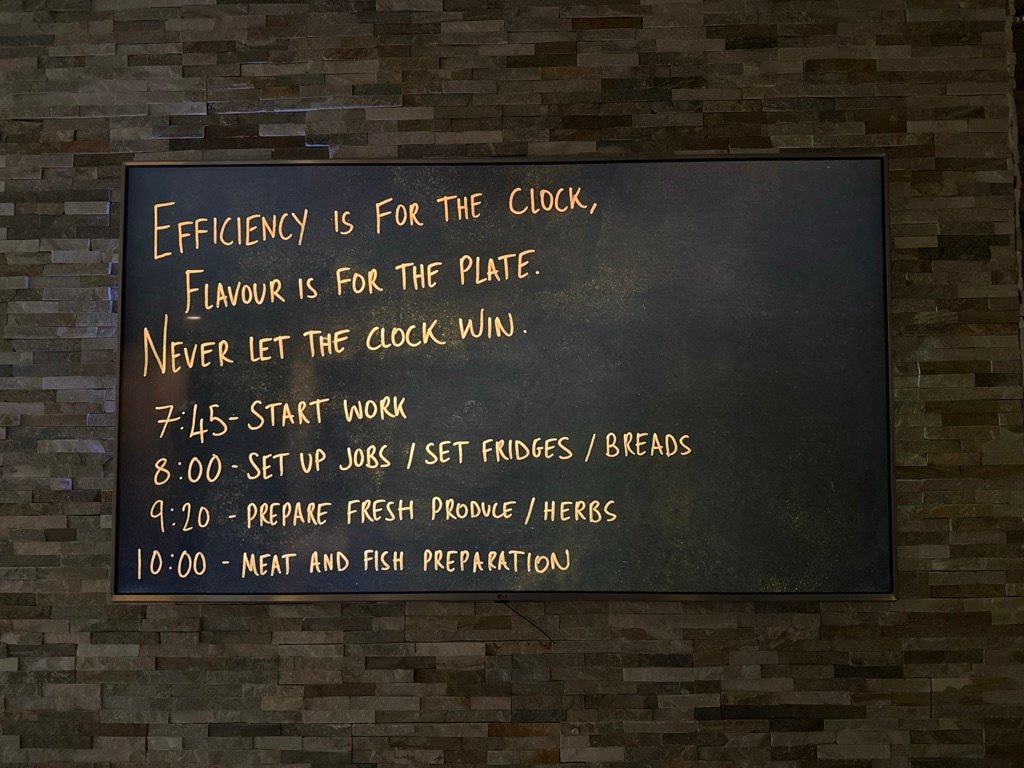
I was watching Knife Edge: Chasing Michelin Stars when this stopped me.
On a board in Gareth Ward’s kitchen at Ynyshir were three lines:
“Efficiency is for the clock. Flavour is for the plate. Never let the clock win.”
What caught my attention wasn’t only the quote. It was what was written immediately underneath it.
7:45. Start work. 8:00. Set up jobs. 9:20. Prepare fresh produce. 10:00. Meat and fish preparation.
This is not a kitchen that rejects efficiency. It is a kitchen organised around it.
But efficiency knows its place.
The clock helps run the kitchen. It doesn’t decide what leaves it.
We have spent a long time chasing the clock
Much of modern business has been built around efficiency.
We optimise utilisation. We standardise processes. We measure productivity. We create templates, workflows, dashboards and operating models.
None of that is inherently wrong.
The problem starts when the machinery that was supposed to help us do better work becomes the work.
I see this constantly.
A marketing manager should be thinking about customers, ideas, propositions and what campaign to create next. Yet a significant part of the week can disappear into gathering numbers, reconciling reports, building slides and explaining what happened last week.
A salesperson should be talking to customers. Instead, time disappears researching accounts, updating CRM records, writing follow-ups and moving information between systems.
Consulting is no different.
Somewhere along the way, highly experienced people started spending extraordinary amounts of time producing status reports, reformatting presentations, summarising meetings, finding information and administering the work around the work.
We became very good at the clock.
Then AI arrived
A lot of the conversation about AI is still centred on productivity.
How much faster can we do this?
How many hours can we save?
How many tasks can an agent perform?
How many people will we need?
Those are legitimate questions. The economics are real, and pretending otherwise doesn’t help anyone.
But I think there is another question worth asking.
What are we going to do with the time we get back?
Because if the answer is simply more, we may be missing one of the biggest opportunities AI gives us.
If AI can produce the weekly performance report, perhaps the marketing manager can spend that time understanding why customers behaved the way they did and deciding what to try next.
If an agent can research a prospect, prepare the context and handle the administration around a lead, perhaps the salesperson can spend more time listening to the customer.
If AI can transcribe the workshop, structure the notes, find the relevant research and produce the first draft, perhaps the consultant can spend more time thinking about whether the recommendation is actually right.
That is a very different definition of productivity.
It isn’t simply doing the same work faster.
It is creating room to do better work.
The tool is getting extraordinarily good
This became particularly clear to me at Dreamforce this year.
Listening to Jensen Huang, Dario Amodei and Sam Altman, there were very different perspectives on where AI is taking us and how quickly we will get there.
There are good reasons to take both the opportunity and the disruption seriously.
But beneath those different perspectives, one thing seems increasingly difficult to argue with: the capability of these systems is advancing remarkably quickly.
Things that recently required specialist knowledge can now be attempted by almost anyone with the ability to describe what they want.
Writing. Research. Analysis. Coding. Design. Data interpretation.
That doesn’t mean expertise suddenly stops mattering.
I think it changes where expertise matters.
When producing something becomes easier, producing something good becomes the challenge.
AI can give you twenty ideas.
It doesn’t necessarily know which one deserves to survive.
It can create a strategy deck.
It doesn’t have to sit across the table from the client when the strategy fails.
It can generate a technically correct answer.
It doesn’t carry responsibility for whether that answer was the right one.
The ability to produce is becoming abundant.
Judgement isn’t.
That is where craft comes back
Craft is sometimes mistaken for doing things the old-fashioned way.
I don’t see it like that.
A chef doesn’t become less of a chef because the kitchen has better equipment. An architect doesn’t lose their craft because they stopped drawing every line by hand. A photographer isn’t less skilled because a modern camera can autofocus.
Better tools have always changed craft.
The craft moves.
It moves towards judgement. Taste. Experience. Curiosity. Knowing what to keep and what to discard. Seeing something that isn’t quite right when everybody else thinks it is good enough.
And, perhaps most importantly, caring about the person on the receiving end.
That last part matters to me.
There is a phrase I keep returning to: live to serve.
Not in some grand philosophical sense. In the very practical sense that good professional work starts with understanding that the work exists for somebody else.
The guest doesn’t care how efficiently the kitchen operated.
They care about what arrived on the plate.
The customer doesn’t care how sophisticated your transformation programme was.
They experience whether the company made their life easier.
The client doesn’t care how quickly the presentation was produced.
They care whether you understood their problem and helped them make a better decision.
AI can make much of the machinery behind those experiences dramatically more efficient.
Good.
Let it.
But don’t give the clock the plate
There is a temptation with every new productivity technology to take the efficiency gain and immediately fill it.
A task that took five hours now takes one?
Great. Do five of them.
A team can produce twice as much?
Increase the target.
A consultant can create a presentation in half the time?
Give them another presentation.
We should be careful.
Because if every minute AI gives us back is immediately converted into additional throughput, we will have achieved something remarkable technologically while changing surprisingly little about work.
Perhaps some of that time should remain deliberately inefficient.
Time to think.
Time to challenge the obvious answer.
Time to talk to a customer without an agenda.
Time to make something slightly better even though the first version technically works.
Time for a marketing manager to have an idea.
Time for a consultant to say, I know this is what we were asked to build, but I don’t think we should build it.
Those moments are difficult to capture in a productivity metric.
They are also often where the value is created.
Craft is back
I don’t know exactly what AI will do to every profession. Nobody does.
Some jobs will change dramatically. Some tasks will disappear. New ones will emerge. And there will undoubtedly be difficult consequences alongside the opportunity.
But I don’t believe the conclusion should be that human contribution becomes irrelevant as machines become more capable.
I think it places a different responsibility on us.
If the machine can increasingly handle the mechanics, we have fewer excuses for neglecting the craft.
Spend less time reporting on the work and more time improving it.
Less time moving information around and more time understanding what it means.
Less time administering relationships and more time having them.
Less time producing things simply because the process says they need to exist.
And more time asking whether what we are producing is actually any good.
Which brings me back to that kitchen in Wales.
The schedule starts at 7:45.
The jobs are organised.
The ingredients are prepared.
The clock matters.
Of course it does.
But the clock doesn’t eat the food.
AI should make the clock better. It should not decide what goes on the plate.
Efficiency is for the process.
Craft is for the outcome.
Never confuse the two.